Bottle Village, officially known as Grandma Prisbrey’s Bottle Village, is a nationally and internationally recognized folk-art environment in Simi Valley, California. Built almost entirely from discarded bottles and other castoff objects, it is listed as:
City of Simi Valley Landmark
Ventura County Landmark No.52
California State Historical Landmark No. 939
National Register of Historic Places (1996)
Affiliate member site of HAHS, National Trust for Historic Preservation’s (Historic Artists’ Homes & Studios) (since 2025), placing Tressa “Grandma” Prisbrey among the company of such internationally noted American artists as Georgia O’Keeffe, Edward Hopper, Andrew Wyeth, and Norman Rockwell.
Although Bottle Village was closed to the general public in 1984 and suffered major damage in the 1994 Northridge earthquake, monthly pre-arranged tours are still available at Bottlevillage.org
What Is Bottle Village?
Beginning in 1956, at age 60, Tressa “Grandma” Prisbrey spent 25 years at the site transforming a long, narrow one-third-acre lot (250 feet by 50 feet) into a dense, interconnected world of buildings, shrines, walkways, and sculptures. Working mostly alone, she created:
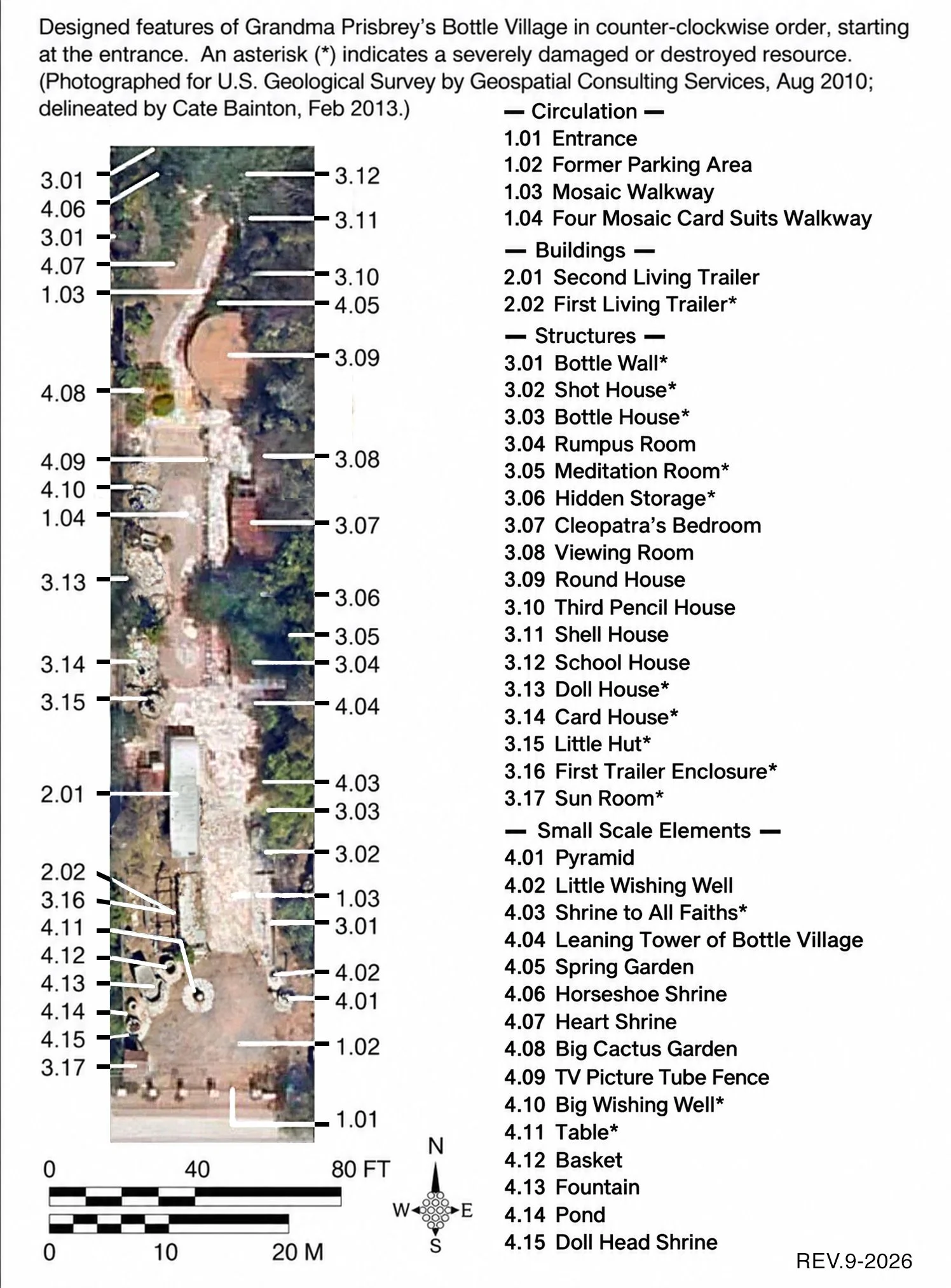
• 16 small one room structures
• Extensive mosaic sidewalks and floors
• Fountains, wells, planters, and shrines
• The Leaning Tower of Bottle Village
• The Dolls’ Head Shrine
• Cleopatra’s Bedroom
• The Round House
• The Shrine to All Faiths
• The Television Tube Fence
• The Headlight Garden
• Wishing wells, a Pyramid, a Cactus Garden, and more
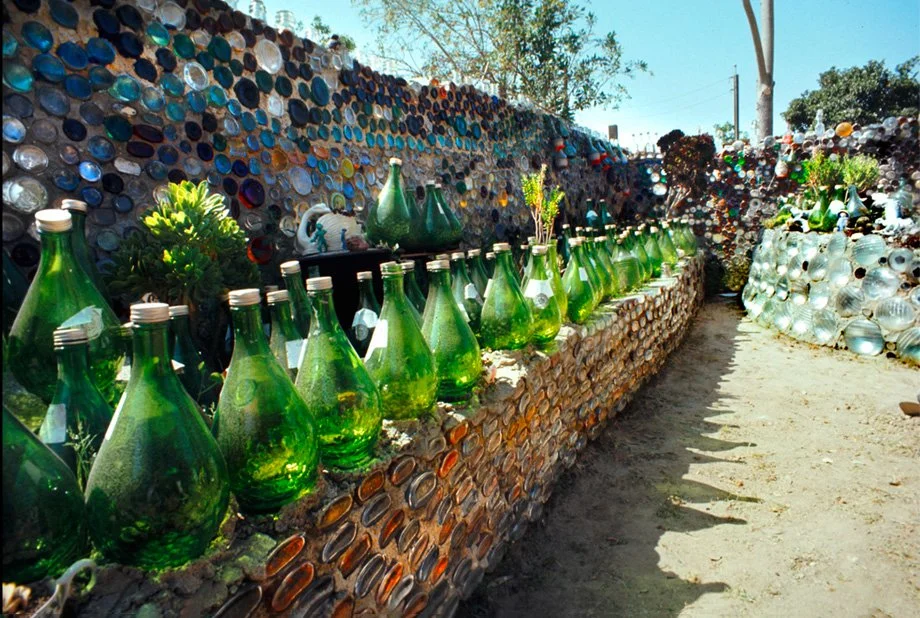
Everything was made from reused materials — bottles, broken tiles, headlamps, TV tubes, springs, dishes, toys, and countless other castoffs from mid-20th Century American life. Art historians describe Bottle Village as one of the few major art environments built almost entirely from trash.
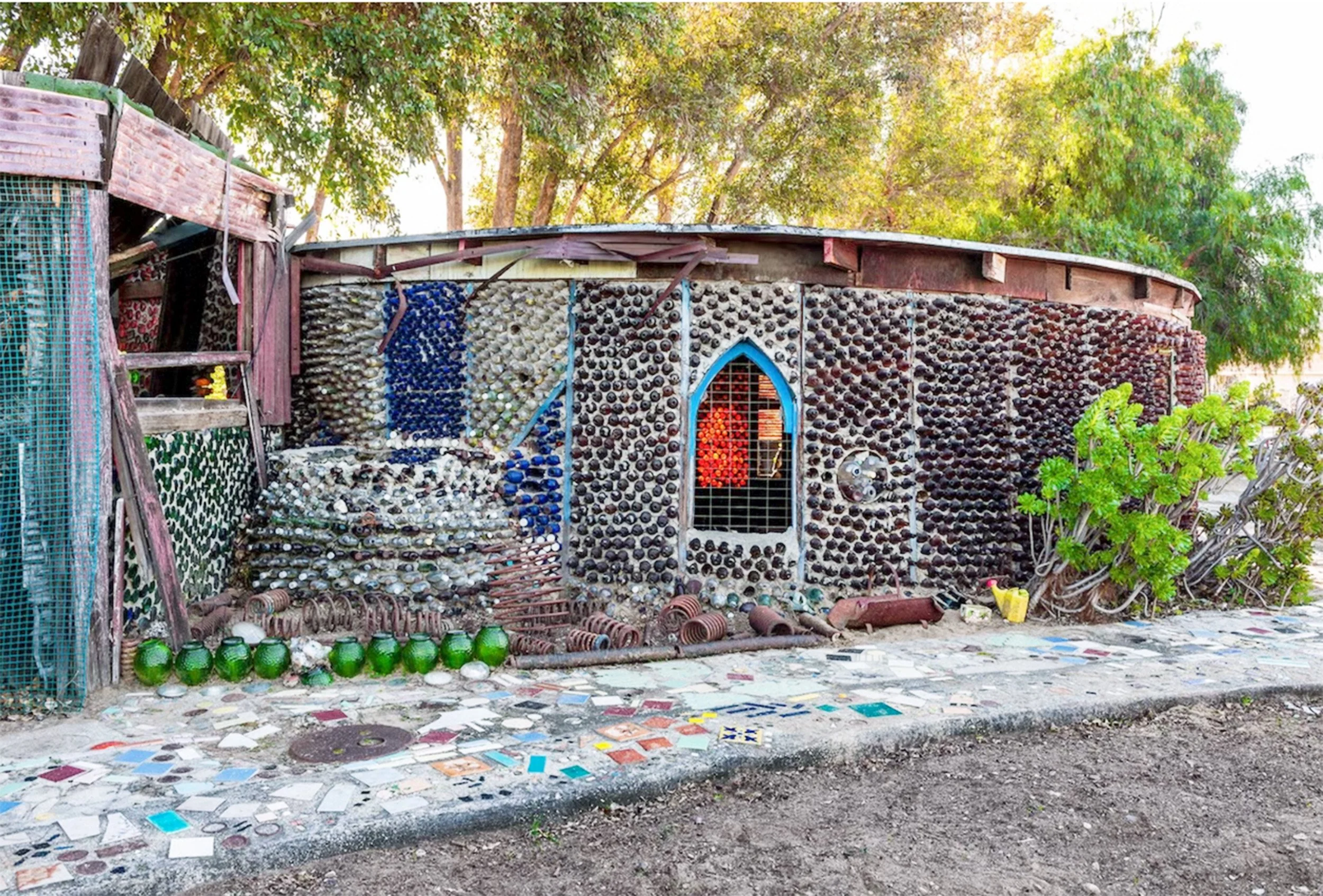
Bottle color and placement were crucial to Prisbrey’s designs. Common amber and green beer bottles, clear bottles (often painted inside), and especially cobalt blue Milk of Magnesia bottles create stained-glass-like light and patterns inside the buildings. Walls are carefully ordered: bottles grouped by size, type, or color, and either protruding inward or outward, but never both in the same wall.
Interiors were designed as display spaces for her collections, such as more than 200 hand-painted gourds and over 600 dolls. Floors and walkways are mosaics of broken tile and embedded objects like scissors, license plates, cups, cigarette lighters, and toy guns.
Prisbrey completed nearly all the work herself. Her sons helped with some roofs and heavy tasks, but she laid the walls, mixed mortar, set bottles, wired the buildings for electricity, and invented the designs. Most roofs are corrugated metal on simple wood framing; foundations are shallow, hand-dug, and floors are cement mosaics.
The Making of Bottle Village: From Pencil House to Folk-Art Landmark
In 1956, at age 60, Tressa began the Bottle Wall, a retaining wall along the east side of the property, and shortly after built her first structure, the First Pencil House (also called the Shot House). She needed a place to store her 17,000 plus commemorative pencils. When she discovered how expensive concrete blocks were, she turned to the dump:
“I went to get cement blocks to build this house for my pencils and, my God, they were so expensive, so I went over to the dump, and I thought, ‘I’m going to make it out of bottles…’”
She did exactly that, starting with bottles from her husband’s “bad habit” and then combing the local landfill daily in her Studebaker truck. Soda bottles were usually returned for the 2cent deposit, so she found mostly milk of magnesia and alcohol bottles, along with an endless stream of household scraps.
Between 1956 to 1965, she added 15 more small structures, including:
• Second Pencil House (Bottle House)
• Third Pencil House
• Rumpus Room
• Meditation Room
• Hidden Storage Room
• Cleopatra’s Bedroom (Gold Room)
• Viewing Room (Old House)
• Round House
• Shell House
• School House (Relaxing Room)
• Doll House
• Cabana (Card House)
• Little Hut
• Sun Room (Little Chapel)
• Enclosure for the original trailer
Each building is one story, one room, and large enough to enter. Each has a theme, often tied to the contents, such as the Doll House, where she displayed over 600 dolls and routinely changed their outfits, referring to them as “the ladies.”
Prisbrey’s construction methods evolved over time:
• Early buildings: simple rectangular bottle walls acting as load-bearing structures with no additional framing.
• Later buildings: timber or 2x4 framing with bottle infill, round or nonorthogonal footprints, and more complex structural arrangements.
Her mortar was usually three parts sand to one part gray cement, sometimes bright white cement around blue bottles for contrast. She built up only a few courses of bottles per day to allow curing. Most buildings had electricity; only the Shell House had plumbing.
Interior decoration used salvaged fabrics stitched together to cover ceilings, handpainted objects, and carefully arranged collections. Some buildings also contained custom furniture to match the theme, such as a round bed in the Round House.
In addition to buildings, she created an array of freestanding works:
• The Headlight Garden: a rose garden for her daughter with car headlights used as “flowers.”
• The Las Vegas Card Suite: heart, diamond, and spade stepping stones, inspired by a trip to Las Vegas, filled with recycled objects.
• Horseshoe Shrine, Heart-shaped Shrine, baskets, fountains, shrines, wishing wells, and extensive mosaic walkways.
As her collections and ideas grew, she built more structures to house them. When she ran out of room, she turned her attention to decorating every available surface.
PERSONAL VISION, GRIEF, AND HEALING
Art historians and folklorists view Bottle Village as a deeply personal, complex work. It reflects several intertwined goals:
• To create shelter for her many collections
• To memorialize family, friends, and important life events
• To transform the discarded remains of consumer culture into beauty
• To find emotional release and meaning after profound loss
Six of her seven children (four sons and two daughters) died before she did. Several structures and shrines are directly tied to her grief:
• The Heart-shaped Shrine memorializes her daughter Velma, who died at 35/36.
• The Shell House was built in two days after she learned one of her sons, ill with cancer, would return to her care.
• The Headlight Garden was created when another daughter, who loved flowers, was diagnosed with cancer; Prisbrey told how, on the day her daughter died, the roses in the garden “died” too.
Historian Daniel Wojcik notes that many so-called “outsider artists” create in response to adversity or personal crisis. He sees Bottle Village as a form of psychological reconstruction:
• By rescuing discarded objects and reassembling them into ordered, beautiful structures, Prisbrey created a new sense of order from chaos.
• Her environment is filled with baby dolls, mother-child imagery, hearts, and family photos, evoking both her children’s childhoods and her own lost youth.
• Because she seemed to struggle to verbalize her grief, building became both escape and catharsis.
• Interaction with visitors helped ease her loneliness and reinforced her self-worth.
Prisbrey herself framed it more simply:
“If you’re feeling bad, find something to do and do it!”
and:
“If you think you are slipping, just get a hobby that will take your mind off of how you feel and give yourself something to look forward to.”
BOTTLE VILLAGE AS FOLK/OUTSIDER ART
Bottle Village is widely recognized as a major “outsider art” or folk-art environment. Such sites are usually:
• Built by self-taught artists, often in middle or later life
• Constructed without formal plans
• Large-scale, handmade, and attached to the creator’s home or business
• Made from ordinary or discarded materials reused in imaginative ways
• Motivated by personal satisfaction or vision rather than commercial goals
Seymour Rosen, a key documenter of these environments, described them as “handmade, personal places” built from accumulated, transformed objects, often on a monumental scale. Bottle Village is a classic example.
At the same time, contemporary artists such as John Cage, Robert Rauschenberg, and Marcel Duchamp were experimenting with “assemblage” in galleries and museums, Prisbrey — unaware of the movement — was assembling objects directly on site. Instead of placing single items on pedestals, she embedded them into walls, floors, fences, and shrines, creating new relationships and meanings.
Art scholars have called Bottle Village “monumental” and note that Prisbrey was one of the first women artists to work extensively with plastic and mass-produced media, and to use a full-scale house motif (the Doll House) to explore themes of maternity and domestic life.
TOURS, DAILY LIFE, AND PUBLIC RECEPTION
Bottle Village quickly became a modest but well-known tourist attraction. Visitors came from around the world, paying small fees — adults a dollar, teens 50 cents, children 25 cents (earlier 25 cents for everyone). She guided walking tours herself, sharing stories and jokes.
Tours often ended in the Meditation Room, where she played piano and sang risqué songs from the 1920s. She embraced the nickname “Grandma,” accepting it from strangers as easily as from family.
The Los Angeles Times once described Bottle Village as an “eccentric folk-art wonderland.” Kevin Schaller later summed up her importance:
“She was recycling and upcycling before those words were even in use. She led a difficult life yet managed to find joy and beauty in the things that most of us simply throw away without a second thought. And through her unique creations, she may have healed herself: making treasure from trash is such a therapeutic thing.”
Locally, however, reaction was mixed. Some Simi Valley residents saw only junk and an “eyesore,” arguing it was not “real art” or should be moved out of sight. Others recognized its cultural value and pushed for preservation, though that support often came more strongly from the wider art world than from local government.
OWNERSHIP, PRESERVATION, AND EARLY RESTORATION
Tressa lived and maintained Bottle Village until 1972, when she sold the property and moved to Oregon to care for her ill son Hubert. After his death in 1974, she returned and was allowed by the new owner, a local realtor, to live rent-free in her trailer as caretaker and tour guide.
By the late 1970s, her health was declining. She was in her early 80s and had suffered small strokes. In 1979, the Preserve Bottle Village Committee (PBVC), a nonprofit group, formed to:
• Raise funds to purchase the property
• Restore Bottle Village
• Eventually dedicate the restored site to a public agency to ensure permanent protection and public access
A 1979 condition assessment by folk-art specialist Don Howlett found the Village generally stable but with notable problems: missing elements from theft, deteriorating roofs and wood framing, water damage, cracking and leaning walls, poor electrical wiring, and general wear. He recommended emergency roof covers, stabilization of the main Bottle Wall, and eventual comprehensive restoration.
Key milestones:
• 1980: Tressa received a National Endowment for the Arts grant to design and supervise a bottle mural in the new Simi Valley Library. Work and supervision under Grandma Prisbrey was completed by artist Jeff Wack co-founder of The Preserve Bottle Village Committee and assistant to Ms. Prisbrey.
• 1981: Bottle Village was officially designated a California State Historical Landmark.
• 1982: City officials ordered Bottle Village closed to the public due to building code and safety issues.
• 1982: Tressa, in poor health, moved to San Francisco to live with her daughter Othea “Babe” Krieger.
• 1986: The property was gift-deeded to Preserve Bottle Village; a landmark dedication ceremony was held, unveiling historic markers.
• 1988: Tressa “Grandma” Prisbrey died at 92 from stroke complications and was buried in Oakwood Memorial Park in Chatsworth, California.
THE EARLY MASTER PLAN AND PARTIAL STABILIZATION
In 1986 to reopen Bottle Village even in a limited way, PBVC worked with:
• Architects Raymond Girvigian, Mark Bielski, and Albert “Al” Okuma Jr.
• Landscape architect Harry Kobzeff
• Structural engineer John Nelson (Howard F. Stup & Associates)
• Conservators and contractors including Nathan Zakheim and Paul Czirban
The resulting Master Plan:
• Addressed building code violations (sewage, electrical, structure, accessibility)
• Proposed partial, “arrested decay” stabilization rather than full modernization
• Recommended restricting interior access to some structures, while allowing viewing through doors and windows
• Proposed new trailer foundations so the historic mobile homes could remain and be interpreted under the State Historical Building Code
• Outlined new front fencing, marker placement, and limited on-site parking
PBVC secured multiple planning and restoration grants from the National Trust for Historic Preservation, California Arts Council, the Skaggs Foundation, and others. They:
• Collected replacement bottles of the correct type and period
• Cataloged collections and archives
• Organized volunteer workdays, including help from the California Conservation Corps, the National Association of Women in Construction, and local Boy Scouts
• Hosted art auctions and fundraisers, including an AdoptaBuilding campaign
• Extended the Mosaic Walkway for improved access, built a new entry fence and gate, and did minimal stabilization on key features like the Sun Room, Doll’s Head Shrine, wishing wells, and the Leaning Tower
In 1987, after addressing numerous conditions, PBVC received a Special Use Permit (SUP) to operate Bottle Village as a public museum on residential land. However, they had only one year to complete significant structural and seismic work, and the organization struggled to raise the necessary funds.
By 1990, they were facing serious financial strain:
• They lost tax-exempt status due to administrative oversight and had to pay back property taxes, narrowly saving the site from auction.
• A small 1989 earthquake reportedly damaged at least one glass masonry wall.
• Bottle Village was classified as one of the city’s few unreinforced masonry (URM) sites needing seismic strengthening.
Stup & Associates completed detailed seismic renovation plans in 1991, designing to “preserve [the buildings] as historic ruins.” But assembling the funding to carry out those plans proved extremely difficult.
NORTHRIDGE EARTHQUAKE AND FEMA CONTROVERSY
On January 17, 1994, the Northridge earthquake (magnitude 6.7) struck the region, one of the costliest natural disasters in U.S. history. Centered about 18 miles from Bottle Village, it caused widespread damage.
At Bottle Village:
• Five structures and one object completely collapsed.
• Seven structures were seriously damaged.
• One other structure was partially damaged.
• Collections were scattered, “commingled with the fallen walls and exposed to the elements.”
FEMA initially funded an Architecture and Engineering (A&E) Report, awarding PBVC $18,900 to hire:
• Structural engineer Bud Goldstone (noted for his work on Watts Towers)
• Conservator Zuleyma Aguirre (also associated with Watts Towers)
• Architect Al Okuma Jr.
• Photographer Marvin Rand
• Collections expert Mo Shannon (Museum of Contemporary Art, Los Angeles)
The 1995 A&E Report estimated $500,570 for repair and stabilization. After adjustments, FEMA set the eligible cost at $485,000. In November 1996, FEMA approved disaster assistance of $485,000—90% federal funds, 10% local match. Bottle Village became one of only two arts sites (along with Watts Towers) to receive FEMA quake funds, amounting to less than 0.02% of the nearly $8 billion in total disaster relief.
However, in January 1997, Congressman Elton Gallegly introduced H.R. 175 to block federal funds for Bottle Village. Local Councilwoman Sandi Webb led opposition at the city level. Critics called restoration a waste of taxpayer money; PBVC countered with petitions, supporter signatures, and evidence that funds would go to earthquake repair, not preexisting issues, and that the local match would not come from government.
Under mounting political pressure, FEMA froze then rescinded all Bottle Village funding in March 1997, invoking regulations that limited assistance to facilities with established budgets and clear, regular public use. Because Bottle Village had been officially “closed” since 1984, FEMA concluded it did not qualify, despite PBVC’s documentation of ongoing byappointment tours, community group visits, and even a 1991 music video permit for the band Meat Puppets.
PBVC appealed twice:
• The first appeal sought restoration of the full $485,000 and was denied.
• The second appeal successfully restored the initial $18,900 previously spent on the A&E Report.
The loss of FEMA funding was a major blow. Without seismic work, Bottle Village could not regain a special use permit for public operation.
ONGOING DETERIORIZATION AND PRESERVATION
In the years following the quake:
• PBVC carefully cleaned and consolidated fallen materials, keeping unbroken bottles near each building for eventual reuse.
• The site continued to weather and deteriorate; by 2001, observers warned that without intervention it would slide from folk art environment toward archaeological ruin.
• Despite local resistance, Bottle Village attracted ongoing national and international interest, appearing in projects such as the BBC’s “Journeys into the Outside” with Jarvis Cocker and PBS’s “Off the Map.”
PBVC obtained some private grants, including one from the Judith Rothschild Foundation for an Archive and Documentation Project in 1999. That project included oral histories and detailed inventories of stored objects and furnishings.
The nonprofit has continued to:
• Pay property taxes, sometimes barely avoiding tax sale
• Maintain basic security and weather protection
• Host occasional volunteer workdays for cleanup and minor stabilization
• Seek partnerships and funding from the arts and conservation communities
Seismic rehabilitation remains critical. Without it, Bottle Village cannot fully reopen as a museum, and fundraising remains difficult without regular visitor income.
CURRENT STATUS AND FUTURE PROSPECTS
Bottle Village still provokes divided opinions locally. Some residents and officials see trash and decay; others see a unique cultural treasure with significant tourism potential.
There are signs of changing attitudes:
• The Simi Valley Tourism Marketing District, created in 2014, now promotes Bottle Village prominently in its visitor materials.
• Bottle Village remains listed at the top of some “places to go” in Simi Valley promotional efforts.
Preserve Bottle Village continues to advocate in 2026:
• Newly developed administrative and long-range master plans, which are outlined in detail within the FUTURE GOALS section. Major goals of the new plan are to:
Stabilize remaining structures on site.
2. Create a new museum/gallery display building containing original items and some original artist assistant supervised re-creations of Grandmas works. Building will also accommodate audio-visual components to display archival films and photography of pre-quake conditions.
3. Provide new safe public and ADA-compliant walkways to access viewing areas on site along with public restroom facilities. Bottlevillage.org
4. Provide several exterior display kiosks for historical and interpretive information throughout the site.
5. To provide an additional structure for safe archival re-creation display, community, and studio usages.
6. To renovate Grandma’s original trailer for on-site caretaker and artist in residence usage
7. Pursue new partnerships, especially with arts-focused foundations that might sponsor major stabilization and partial reconstruction of significant artistic features.
For now, activity at the site is limited. Personal tours can be difficult to arrange, but monthly private tours are advertised at Bottlevillage.org
GRANDMA’S OWN WORDS
Tressa “Grandma” Prisbrey rarely viewed herself as an artist, but her remarks reveal her philosophy:
“Anyone can do something with a million dollars. Look at Disney. But it takes more than money to make something out of nothing and look at the fun I have doing it.”
“Now some people may think that daily visits to the town dump could be a pretty depressing kind of thing; …well, to me, it is a never-ending source of interest and a priceless experience.”
“A lady asked me where I got my ideas, and where she could get a copy of the book that I got the ideas from. I told her she would have to wait until I wrote my book before she could get any of my ideas, for they are mine alone.”
Through Bottle Village, she turned the debris of modern life — and the debris of her own hardships — into a lasting work of imagination, resilience, and unconventional beauty.
''Bottle Village is one of the woman-made wonders of the world,'' ..."It's an example right beneath our noses of mid-20th-century alchemy, of a woman with no formal training or education who created this magical garden out of discarded flotsam and jetsam.''
— Richard Posner, Glass Artist
"While Grandma Prisbrey didn’t think of herself as an artist, she did some extremely remarkable things. She was recycling and upcycling before those words were even in use. She led a difficult life yet managed to find joy and beauty in the things that most of us simply throw away without a second thought. And through her unique creations, she may have healed herself: making treasure from trash is such a therapeutic thing. Her legacy will continue to endure as long as people are mesmerized by her colorful bottle buildings and off-the-wall trash sculptures." — Kevin Schaller
''Grandma was an O.K. builder, said Bud Goldstone, a retired aerospace engineer who has spent 38 years refurbishing Watts Towers in Los Angeles, the country's most famous folk environment. ''But she didn't build well enough to withstand a 6.7 earthquake.''
''As an engineer,'' Mr. Goldstone said, sounding rather like Mother Goose, ''I couldn't think of a more difficult task than putting a bottle village together again.''
Mr. Goldstone, the engineer who developed the load test that proved Watts Towers were safe after the City of Los Angeles ordered it demolished, said that Bottle Village was repairable. But updating Grandma's site to meet preservation, safety and earthquake rules would take a full-time conservator, a curator of collections, architectural draftsman and photographers and a new technical system to secure her beloved beams and bottles).
— Bud Goldstone, Watts Towers Structural Engineer
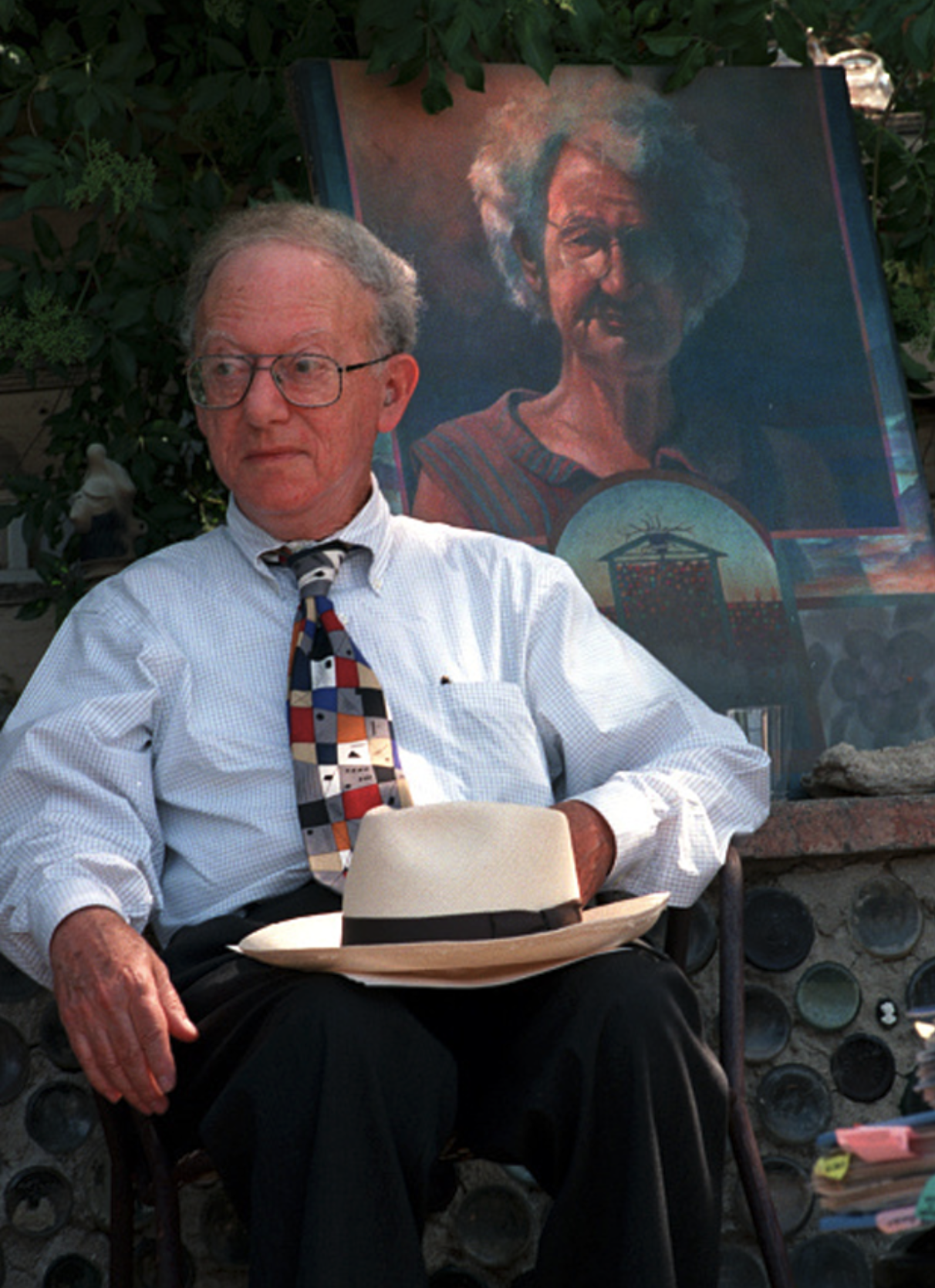
Photo: Mel Melcon, Los Angeles Times 1997
Painting: Jeff Wack 1976
The 1994 Northridge Earthquake struck eight miles away and badly damaged the Village. Because of the severe damage, Preserve Bottle Village applied for Federal Emergency Management Agency (FEMA) funding. In 1997, when it appeared FEMA would award a $455,000 grant to help repair the earthquake damage to the Village, the grant was lost after former Councilwoman Sandi Webb and U.S. Rep. Elton Gallegly, R-Simi Valley, opposed it. Gallegly called it a waste of taxpayers' money. Also, James Lee Witt, the director of the Federal Emergency Management Agency, said his organization had determined that the site was not eligible for Federal disaster relief money because it had not been open to the general public since 1984.
Since the earthquake, Bottle Village has needed support and funding. The late artist Joanne Johnson, who was one of the docents and served for some time on the board of directors (including a stint as board president), wrote that the “crumbling Bottle Village is an ironic paradox – built from castoffs, now cast aside. This piece of Folk Art is the definition of the saying 'one man's treasure is another man's junk'." Because of the disrepair in which the site is currently, there is little activity. Personal tours can be difficult to book, but monthly private tours are available at www.bottlevillage.com.
In the past, Bottle Village has received a few generous grants for maintenance and miscellaneous projects. However, the preservation Committee is currently embarking on efforts for major work proposals on restoration, a visitor center, improved access for the public, and recreation where possible, and will be looking for major funding to accomplish these goals in planned stages. Please view the section on this website entitled "Future Goals" to see the exciting visuals and updates as they take shape.
Photo Credits:
Andrea Hassiba 1981
Mel Melcon 1997
Jenn Joy Jameson Merchant 2024